
The problem we were founded on
Crescent Bioresearch was founded in Albany, New York, around a framework of critical assessment, truth and transparency. The problem it was founded to answer is simple to state. A research entity that buys a compound does not run its experiment on the compound it ordered; it runs the experiment on the compound it received. If the two differ, in identity, in purity, or in what else is in the vial, every result downstream inherits the difference, and nothing in the data will say so.
A standard that cannot be examined is a statement. We set out to publish something that could be examined instead.
Three questions, three methods
Our protocol asks three questions of every lot before it is listed.
What is it? Identity is confirmed by Fourier-transform infrared spectroscopy against the characteristic bands of the compound, following USP <197A>.
How much of it is there? Purity and potency are measured by high-performance liquid chromatography following USP <621>, reported as a percentage and as the recovered mass against the labelled content.
What else is in it? Bacterial endotoxin is measured by the gel-clot limulus amebocyte lysate test following USP <85>, and reported in endotoxin units per vial against a stated limit.
We do not use mass spectrometry, and no certificate we publish claims it.
| Question | Method | Chapter | Reported as |
|---|---|---|---|
| Identity | FTIR | USP <197A> | Spectrum confirms the compound's characteristic bands |
| Purity and potency | HPLC | USP <621> | Percentage; recovered mass against labelled content |
| Bacterial endotoxin | Gel-clot LAL | USP <85> | EU per vial, with limit and lysate sensitivity |
Who does the measuring
None of the measuring is done by us. Each compound sent out for testing is assigned a unique lot number. A sample from that lot goes to an independent third-party laboratory; the current certificates are issued by BTLabs of West Palm Beach, Florida, and carry the names of the scientists who signed them. We receive the report, we publish it in full, and then we open the listing.
The order matters. The certificate exists before the sale does, and when a new batch arrives the cycle begins again with a new lot number and a new certificate. Superseded certificates remain in the library so that a lot bought last season can still be traced to its own record.
The number, not the word
Most certificates in this sector stop at the verdict. An endotoxin specification turns a measurement into a single word, pass, and the measurement itself is left off the page. The word is true, and it is not enough.
Against a limit of 40 EU per vial, a lot measuring 2 EU and a lot measuring 39 EU both pass. One carries nearly twenty times the endotoxin of the other.
Endotoxin is lipopolysaccharide from the outer membrane of Gram-negative bacteria. It survives autoclaving, passes sterilising filters, and is recognised by the TLR4 receptor on immune cells at trace concentrations. In a cell-based model it is not an inert impurity but an active variable. A laboratory comparing results across lots, or trying to explain a result that did not replicate, needs the value. A pass cannot provide it.
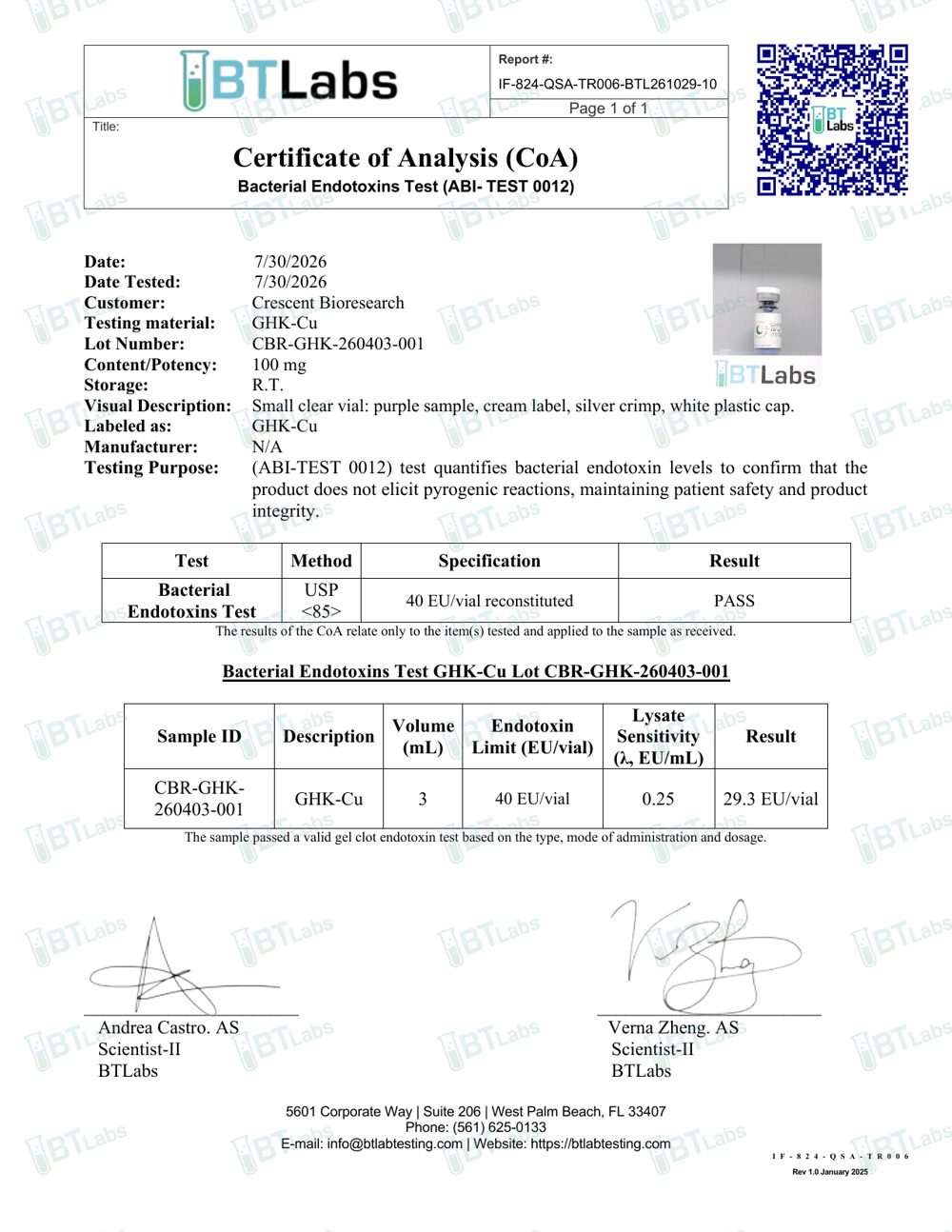
Our certificate for GHK-Cu lot CBR-GHK-260403-001 shows how we report it. The verdict is there: pass, against 40 EU per vial reconstituted. Beneath it the laboratory prints the reconstitution volume, 3 mL; the limit, 40 EU per vial; the labelled sensitivity of the lysate, λ = 0.25 EU/mL; and the result, 29.3 EU per vial. Where a gel-clot reading falls below what the assay can resolve, the certificate states the bound, for instance less than 5 EU per vial, rather than a word.
Why the sensitivity matters
The sensitivity cell is the one most often missing, even when a value is given. A gel-clot test can only detect endotoxin at or above the lysate's labelled sensitivity, so the result is only as fine as λ. Printing it lets a reader judge the resolution of the measurement rather than take it on trust. A value without its sensitivity is a number without a ruler.
What this standard is not
It is not a claim about what any compound does. Everything we supply is for research use only, in vitro, and nothing on this site or on a certificate describes an effect.
It is not a universal cold chain. Temperature-controlled handling is applied where a compound's stability profile requires it, and the storage condition is stated on each certificate.
And it is not finished. A standard is a practice, not an announcement. Each new lot is a new test of it.
To the research entities
Published literature shapes the present and future of scientific understanding, and readers take it as answer rather than as data. The validity of that work rests on the material it was done with. Knowing what is in the vial is the first step towards scientific excellence.
Wishing every laboratory great success and countless scientific discoveries.
In warmth, Crescent Bioresearch